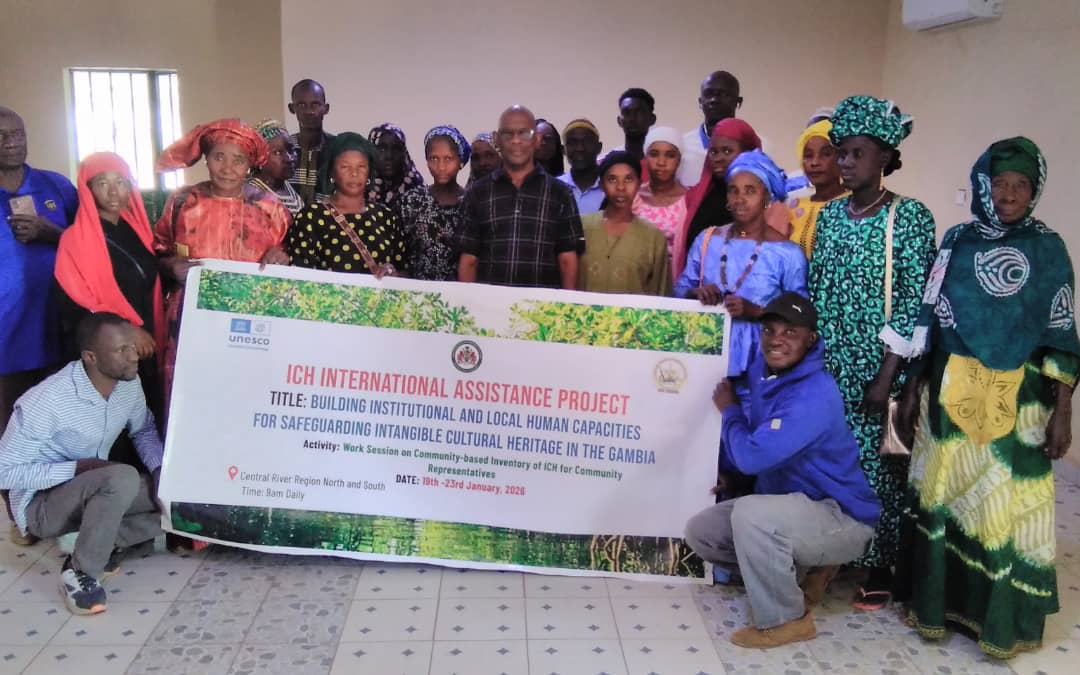
The National Centre for Arts and Culture has held a 5-day workshop to train the community representatives from thirty communities in the Central River Region on safeguarding Intangible Cultural Heritage through community-based inventory.
The activity, which took place in Janjangbureh from 19th to 20th and in Wassu from 21st to 23rd January 2026, is part of the UNESCO-funded International Assistance Project titled ‘’Building Institutional and Local Human Capacities for safeguarding Intangible Cultural Heritage.’’
The workshops were presided over by Mr. Hassoum Ceesay, Director General of the National Centre for Arts and Culture.
The project aims to inventory 90 Intangible Cultural Heritage elements in audio and video forms from 30 communities across the Central River Region over two years.
The community representatives who have been trained at these workshops will assist the NCAC in the fieldwork to inventory the rituals, social practices, festive events, performance, traditional craftsmanship, and knowledge concerning healing for better preservation and transmission.
The community representatives were identified by their respective communities and, therefore, are expected to guide the NCAC to correctly describe the elements identified by the communities.
Mr. Sanna B. Jarju, Director of Literature, Performing and Fine Arts at the National Centre for Arts and Culture and the Focal Person of The Project, explained that the CRR Fieldwork will be a pilot which will later be replicated in other parts of the country.
He recollected that previous activities of the project include the training of trainers by a UNESCO-designated International Facilitator, Dr. Gankhanani Moyo from Zambia, which was followed by an awareness-raising workshop for Local Government Authorities, such as the ward councilors.
He further dilated on the advocacy visit to all identified communities to seek prior, sustained, and informed consent from communities, as well as a radio sensitization program with GRTS and Bansang Community Radio Station, respectively.
Mr. Jarju finally commended the UNESCO 2003 Convention Secretariat and the UNESCO Dakar Office for their guidance and support. He also extended his appreciation to the National Commission for UNESCO Banjul and the network of ICH Facilitators for their continued collaboration.
By Lamin Njie
Communications Officer
Mininistry of Tourism, Arts and Culture