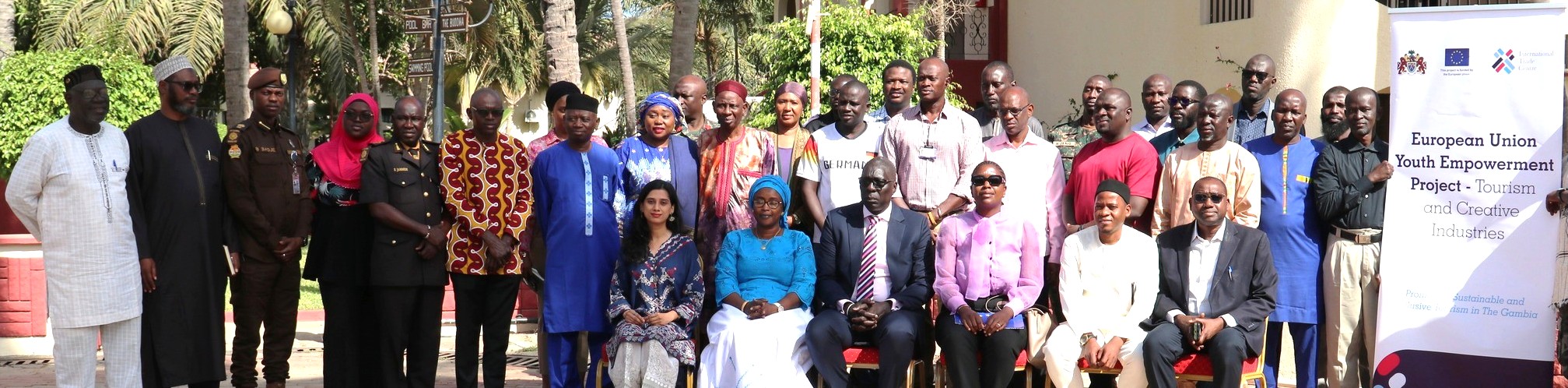
On Tuesday, April 28, 2026, the Ministry of Tourism, Arts and Culture (MoTAC) hosted a one-day National Dialogue forum on Cross-Border Tourism Facilitation and Competitiveness, themed “Building a Unified National Position for Cross-Border Tourism Engagement,” at the Ocean Bay Hotel, Cape Point, Bakau.
The European Union supported the initiative under the EU Youth Empowerment Project–Tourism and Creative Industries and aims to bring together key stakeholders from the public and private sectors, as well as security institutions, to collectively develop a unified national position on cross-border tourism.
The outcomes of this engagement will directly inform The Gambia’s strategy in upcoming bilateral and regional discussions. The program features a series of interactive sessions covering topics such as visa and entry facilitation, border operations, security procedures, and commercial and tourism operations.
The forum is also expected to identify operational bottlenecks, propose practical solutions, and endorse a national resolution charter to guide cross-border tourism engagements.
Speaking at the event, Honourable Abddoulie Jobe, Minister for Tourism, Arts and Culture, said tourism remains a key pillar of our national economy, contributing significantly to employment, foreign exchange earnings, and inclusive growth.
“However, the sector’s full potential can be enhanced with an efficient and seamless cross-border system that facilitates the movement of tourists, goods, and services. In today’s increasingly interconnected world, competitiveness is not only defined by the attractiveness of a destination, but also by the ease with which visitors can access and experience it,” he told the participants.
The minister said the forum provides a timely and strategic platform for the stakeholders to collectively examine the operational realities affecting cross-border tourism, such as focus on visa and entry facilitation, border operations and security procedures, as well as commercial and tourism operations.
“As we engage in these interactive sessions, I encourage all participants to contribute openly and constructively. Your insights, grounded in experience and expertise, are essential in identifying existing bottlenecks and shaping actionable, evidence-based solutions. Whether it is improving visa processes, enhancing coordination among border agencies, or strengthening the enabling environment for tourism businesses, every contribution matters. Let me emphasize that effective cross-border tourism facilitation requires strong collaboration across multiple sectors and institutions. It demands a whole-of-government approach, supported by active private sector engagement and regional cooperation. We must work together to simplify procedures, leverage digital solutions, improve infrastructure, and ensure that security measures are both robust and traveler-friendly, he stated.
Minister Jobe expressed his appreciation to partners and stakeholders who have contributed to organizing this important event, particularly the International Trade Centre (ITC) and the European Union (EU)for the technical and financial support.
For her part, Lumana Kamashi, a prominent representative of the European Union Delegation to the Gambia, said in close cooperation with ECOWAS (Economic Community of West African States), the EU supports a regional initiative aimed at strengthening tourism standards, building capacity, and fostering collaboration across member states. These are key pillars for developing integrated tourism circuits and improving competitiveness.
“The Gambia also participates in the Interreg MAC Programme (2021-2027), which promotes territorial cooperation between West Africa and European outermost regions of Madeira and the Canary Islands. This program supports networking, innovation, sustainable development, and internationalization, key drivers for cross-border tourism development and stronger destination integration,” she said.
She said at the broader level, under the Global Gateway strategy, European investments in connectivity, particularly in transport, energy, and digital infrastructure.
“The Global Gateway Investment Package includes support for connective infrastructure for smart, fair, and affordable mobility and trade within Africa and between Africa and Europe. In this context, the EU has identified the Praia-Dakar-Abidjan corridor as one of the 12 African strategic corridors. The notion of strategic corridors encompasses transport infrastructure (through blended funding), soft measures for trade and transport facilitation, and Road Governance,” he added.
By Lamin Njie
Communications Officer
Ministry of Tourism, Arts and Culture